Tuesday, 13 September 2016

A Lite Ultra in Ireland - Kerry Way Ultralite

Bucolic Ireland beckoned. Green, green and more green. Fertile and fecund. And rain and rain and yet more rain between the showers. "A soft trail" they said, "no mud".


Taking the Emirates route via Dubai I flew the long way to Dublin. Perhaps 18 hours. I forget. But the good people were there to meet and I was hustled into the car for the next 5 hour leg to Killarney, near the western seaboard, and home of the start and finish of the Kerry Way Ultra and the finish of the Ultralite runs. (The 120 mile Kerry Way Ultra is a circular route while the 55km Ultralite is a point-to-point route starting in Sneem and finishing with the bigger run in Killarney).


Why I had agreed to this run escapes me. There was no good reason other than it looked like a nice place to run with a profusion of seductive and captivating pictures littering the internet. I am a real sucker for pretty places. So Killarney it was and on arrival it was explained that this town, in the Kerry district, is the heart of holiday country in Ireland, luring visitors from all over and especially from America.


Killarney is a small town with a vibrant tourist buzz contrasting with the relaxed demeanour of the locals. It was also surprisingly busy with vehicular traffic, alarmingly interpolated with anachronistic horse carts. The tolerance and respect for the equine tradition was a real eye-opener and increased my respect for the locals exponentially even though I do not have a distinctive affinity for horses. I knew I was amongst a people that cared.

The Kerry Way Ultra is a mad thing. I have said this before and I stick to it. It's a 120 miles of madness, and a solid 60 miles of madness beyond my own affliction. However in 2016 they introduced the Ultralite which at a meagre 55 kilometers was an instant "yes" for me.
The day before my run I was at the briefing and the start of the big 120 mile event which left Killarney at 6am on a Friday morning at an unremarkable location on a main road exiting the town. The group of about 50 ultra-ultra runners left in good spirit and weather, with the first rays of sunshine awaiting 20 minutes ahead. I walked back to my hotel and started eating peanut butter sandwiches. I had a day to pack in the carbs and fats that I thought might help me on my "short" run and 6am was a fine time to start the grazing.

Beautiful people at the start of the 120 mile Kerry Way Ultra 

Before arriving in Killarney I had liaised with a few locals in an attempt to get an idea of the terrain and the footwear that it would tolerate. In all honesty, having now run the route I can safely say that the locals were either taking the "piss out of me" or they are of a significantly sturdier strain of homo erectus. (Could it be the Vikings that settled in Ireland over a 1000 years ago?). Put simply the Kerry Way Ultralite was, for me, tough going and damaging to my feet. It was far from what I had expected . But it is still one of the finer runs I have done.
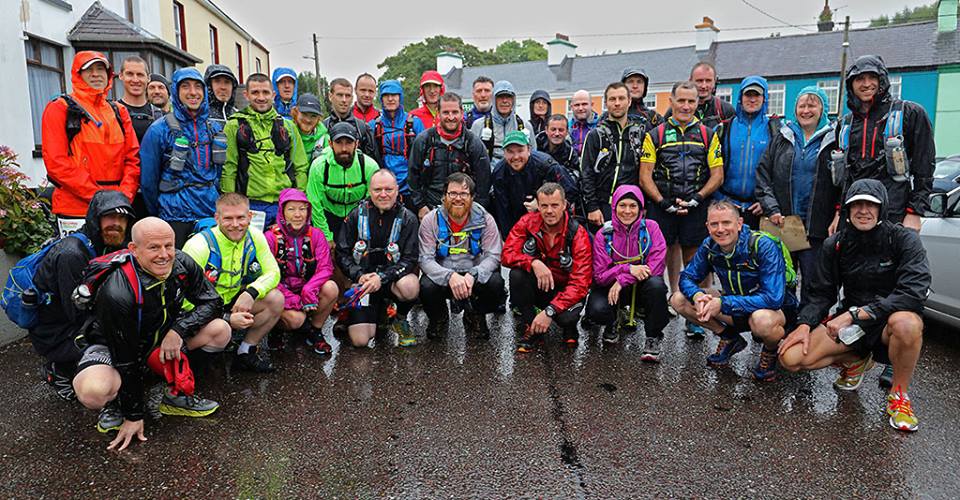
55km Kerry Way Ultralite runners at their start - with rain

Awakening on Saturday morning, a few hours before the start in Sneem, I peered through the hotel window into the early morning darkness. Then I heard the rain. Damn, it was raining. And when I looked downwards at the wet gardens and contemplated how soundly I had slept, it dawned on me that it had probably been raining all night. In an instant I knew my preferred sandals would not be good for the run. I simply could not afford the risk especially in unknown territory. The Newtons would have to do it and that was that.


The night of deep sleep, before the start, was a signal of the issues we faced. More specifically it was the rain during the night which continued well into the run. Leaving the hamlet of Sneem which is where the 55km run starts we pranced down a stony twin track which was actually two small streams running side by side abutted with treacherously muddy mud. Running in the streamlet was manageable but occasionally I ventured sideways to step on what looked like a drier piece of turf only to sink ankle deep in mud with the accompaniment of audible profanity. Thloooschp ... I pulled my foot upwards, escaping the scatalogical mud but.... but leaving my loosely laced shoe haplessly trapped in the boorish clay coelenterate. This will end soon I thought optimistically at 500 meters into the ultra. And so it did at around 35 kilometers and then only for a while. As they say: death is the only cure for stupidity.

How deep is it?

Mud of the order that Ireland presented on the day I ran the Kerry Way Ultralite was of diabolical proportions. The were vast landscapes of mud. Entire hills of mud, often mixed with eons of cow and sheep faeces. The redolent odour from my shoes, since thoroughly washed twice, confirms this assessment. And there were styles. At first playful little obstacles mildly challenging in the wet but after 20 or 30 of them I had visions of slipping and (in South African colloquialism), "blikseming off and moering" my head into the mud ... or a rock. At times there were wooden planks, coated with wire, placed over the perpetually muddy sections to offer light relief. At times there were also insidious and perfidious deep bogs. These were life-sapping death pits from which the paleontologists regularly extract cured remains of early Gaelic people. I know of runners that sank chest deep into some of these soupy carcass-craving bogs.


The Kerry Way runs follow the Kerry Way walking route which is a mix of mountain path, track and some roads through local villages. This kind of mixed terrain produces very interesting and engaging running especially for the likes of me who is known to miss key signposts. I knew the start of my run was in a small village called Sneem and I knew we would also run through other small locations with quaint names such as Templenoe and Kenmare. Knowledge is a powerful tool and in preparation I had looked at the route profile at least once. There was only one thing I remembered - the climbs start at about 35 kilometers. Thus in perfect synchronicity at 35 kilometers coming over a small rise into Kenmare my right hamstring capriciously cramped reducing my jog to an instant hobble. I passed two men who immediately pulled a fresh unopened bottle of water from a bag and insisted that I drink as much as I needed. What generous people? Gladly I accepted realising that I had not been drinking enough. My legs eased and I started moving. At the checkpoint I removed my shoes to pour out a collection of Irish rocks, stones, sticks, gravel and the odd boulder that I had gathered and carried since the start at Sneem. I saw the chafed, raw and bleeding holes in my feet and the helpers were very quick to offer plasters and other remedial wrapping. I declined. The damage was done. I really didn't care. I was happy.

One of a few mud-and-gravel-abraded "holes" in my feet.
My shoes were hopelessly too loose and I didn't bother to
retie the laces

The rain persisted and running from Kenmare to Killarney the route takes a long and steady climb over a series of hills taking one into the heart of Kerry countryside. What a splendour. The cloud colours, fast and black, grey and white, descending and rising. The wind, cold and vocal. The green, orange, purple heaving terrain. The abundant rivers, black water and fervent froth breaking banks, flowing forcefully. I was deliriously lost in the remoteness .... deliriously also missing the vital turn-off and gleefully running an unnecessary mile to a small road where cyclists pointed out that I was not where I should be. "Go back" they said "and look for a little path that goes off to the left". Fine people the Irish.


There were so many really good encounters on the run. The people were really exceptional. Everybody. The last 5 kilometers to the finish in Killarney is through the Killarney National Park which includes Muckross Lake and Lough Leane, an even bigger lake. What better time to run through this expanse than on a Saturday afternoon with all the other visitors - a revivifying treat capping a wonderful day.

And then the finish, in true spartan glory ... on the sidewalk at a rather unremarkable spot, but at least in Killarney.


Pictures include those provided by the organiser and are of both the 120 mile and 55km  overlapping event.


Some details: Entry to the Kerry Way is limited. I think about 50 entered both the 120 mile Ultra and the 55km Ultralite. More than half of the 120 mile Ultra starters did not finish. While many do not normally finish the rain and thick mist were additional issues in 2016. I think all starters of the 55km run finished but about 10 failed to show up at the start - did the weather put them off?

Saturday, 18 June 2016

Why We Run

    
Runners are intelligent. Optimistically we think this, knowing for instance that runners are the only species that wilfully damage themselves to the point of bone fracture as in stress fracture. But overlooking this occasional lapse of cerebral-acuity lets agree that runners are smart and by definition this begets a little curiosity, a little questioning. Runners generally, are searching … for something.

Contrary to popular self-help schmaltz runners are not seeking space, nor peace, nor quiet ... nor introspection nor reflection. Sure, these worthy benefits may descend upon runners temporarily blessed with a “runners high”. But even though we may not know this, runners are searching for something else.

In the shallow waters of pop-psychology running is also an exploration, a pursuit of limits, an embrace of boundaries, a discovery of vitality and exhaustion, of purity and venom, of exuberance and anguish. Yes, running is all of these things that bloggers and cheap health-literature eulogise. But this is not all. More than all of these running is simply a search.

sandal running johanneburg natural zones - south africa

Running is a search for a touchstone, a point of reference. Runners are looking for something .... an anchor; something that may even obviate the need for additional running.

When our creativity evaporates and we struggle to communicate coherently and our efforts feel futile and pointless, and we basically drop below par, we run. We look for renewal.

When feeling distanced from communities and faced with vacuous social convention, we run. 

The tedium of repetitive anecdotes from dull unchanging people drain our enthusiasm and drive us to run. When we need a break we run in search of spirit.

When friends are mildly or strenuously tiresome and warm authentic conviviality disappears, we run. (Sometimes we have to take care of ourselves first.)

When families test our limits and challenge our sensibilities, when we need a counterpoint to the noise of close blood we run to reclaim wholeness. 

When we question a god or anything close, perhaps unknowingly, and we nurture doubt about issues we cannot fathom, we run in search of our soul. 

As runners we know that we don’t know. There are big questions, really big, for which we do not manufacture or contrive a response, even though others might. This brutal honesty is manifest in our chase. We search for absent endpoints, we hope for certainty in pervasive doubt. We hunt an ephemeral truth. Runners move beyond the comfort of knowing, we debate, question and search. We move closer to an emptiness that others avoid or deny. And through this, our search itself becomes an anchor, our running defines the absent goal. 

We run in search of truth and the run itself becomes that truth … even though we may not know this.


thanks to tallguysurfing.blogspot


Tuesday, 16 June 2015

Barefoot Birthday: 5 Years Without Shoes

I am at an age where my running will not easily get faster, but I have noticed it can get better.

Almost 5 years into minimalist and sometimes barefoot running I thought it might be useful to take stock and see what I have learnt, if anything.

Hiking the Fish River Canyon Namibia 2012

Firstly I guess the big prize is that I am actually running. I have shown charts before that reveal the precipitous decline in the numbers of people running once they reach the age of 40. And when they get to 50 the decline in the incidence of running is yet more dramatic. So there's the first prize. Still running after all these years. But allied to that is the prize of being injury free. In fact it is more than that. Being injury free is one thing. Being strong, free of any pain and other niggles is another. 

Foot of Africa Marathon 2012

Second prize is actually enjoying running. Running is a human expression. An expression of joy, of life. People do not run when they're sad. Running happy is a prize. Moving out of shoes and into something less is a release. It allows a refocus and some of that refocusing is on the joy of running (not the shoes). Shoes are a sensory deprivating accessory (is deprivating a word?). More shoe means less happiness. Adding to enjoyment is the fact that changing the game plan is fun. Simply chasing the same goals year in and year out can get a bit dull. Changing the formula and taking on new challenges, spices things up. 

T Rocket 1st Iteration for the Foot of Africa (T Rocket ... Trevor's Rockets)

The third prize is rediscovering posture, form, core strength and vitality. A few years back at a session with a physiotherapist I was told to stand up properly. My habitual stance was wrong. My hips were forward, my head and neck backwards, my legs straight and so on. I was not sure what the physiotherapist was talking about at the time but now I know that my stance has changed and I can feel the difference. My legs are a little more elastic, my knees have a some flex, and my torso feels a little sturdier. It feels like I could stand up for a long time, possibly a very long time. At least that's what I like to think. This means that movement is a little easier and maybe a little more graceful.

Fourth prize is connecting with people. Running in sandals or barefoot elicits comments from others. I mean, .... it's an invitation! It took me a while to work out why this was happening and now I think I have discovered the answer. People are curious about the fact that you run in something less than shoes. But this only explains part of their reaction. The often overlooked reason for their intrigue goes beyond their mere fascination. By wearing sandals or worse still going barefoot, you have challenged the establishment and in short you have given the status quo the "middle finger". This is troubling to those seeking consensual group comfort. It's like arriving in shorts and a t-shirt when the invitation clearly said "Dress: Formal". Some guests are bemused, some are intrigued and some are offended. Whatever the reaction you get noticed and you connect ... not with all, but with many more people. 

Besides those that you meet on runs there are, of course, all the other barefoot and minimalist runners that share the same passion. What a fine bunch of people! 


Hanging around before the Foot of Africa 2013

Fifth prize is mindfulness. Not only mindful running (sorry Fred!) but mindful living. By removing the faux comforts of modern excess and connecting authentically with the earth, a slow process of centering commences. One learns, or at least is encouraged to learn, what matters and what does not  matter. Those that understand this will get it, and those that do not, wont. Running barefoot is instructive. One of my learnings, and this emerged slowly given my personality type, is that I am happy to run as far as I can with as little as I can. That is an end in itself. I do not need to run 100 miles (I am sure I cannot, anyway!) if it means I must I must forego the simplicity and elegance of running barefoot, or minimalist. Put differently if running 21km's barefoot is truly enthralling, absorbing and revivifying, why should I go further in shoes? And this is also a metaphor .... for life.


Cape Town Marathon 2014 (1st barefoot 42)

I could go on. There are many more benefits that I would not give up.  

Thus after 5 years I look back and know that I would have it no different. During those 5 years I have hurt myself several times (mostly self inflicted) and suffered a few embarrassments, but they have all receded into vague memory and are clearly the cost of breaking free.

For some time I was keen that one should encourage and motivate others to discover the benefits of running "lean"  and minimal, but I have changed. The best teachers offer examples. Don't tell others .... show others.  


Comrades 2015 - 22 years after the last.


Friday, 28 November 2014

Are Women naturally more Intelligent than Men?

It was an interesting day. During the morning I fitted Carmen with new Pocket Rockets and she exclaimed "Oh these are great". It was not her first pair of T Rockets and she has plans for another pair soon. It made me think that in the few years that I have been promoting the T Rocket range of sandals, women, generally have been more receptive than men to the thesis of natural movement (meaning zero elevation, midfoot striking, and so on). I wondered why? Perhaps women are less threatened by novelty, perhaps men are too macho in their mindset? Of course I am generalising but it is true that I have found women to be more inquisitive and open to the concept of minimal footwear.


Later in the day I was pleased to meet my friend Dr Bernhard Zipfel for a light lunch. While Dr Zipfel is the Collections Curator (palaeoanthopology) at the University of the Witwatersrand  he is also a  T Rocket wearing podiatrist and is known as the "evolutionary podiatrist" amongst his colleagues. During lunch and without any prompting Bernhard asked me if I had noted any difference in the response of men and women to T Rockets. Indeed I had, I replied adding that it had occupied my thinking earlier that very morning. We chatted about women being more predisposed towards open flat sandals for regular leisure wear. Perhaps this means they are more willing to wear sandals for outdoor athletic pursuits. But I wasn't sure. Perhaps women are simply more intelligent, I said. And yet again perhaps there is an inbred male need to play the role of a defender (or even aggressor) and this does not sit comfortably with open sandals.


Well, the argument about women being more intelligent took a little knock later in the day when I went to run our local Thursday night time trial. After running barefoot from my home to the sports ground I sat on the field putting on my sandals while the crowd assembled for the start of the time trial. There was muted chatter. At this point a women turned around and looking down at me, still sitting and the grass and tensioning my P Rockets, she said: "Did you have a wardrobe malfunction?" What an inane, neolithic and unnecessary utterance! I was speechless and simply stared back with a benign and featureless expression. I know that some people have struggled to accept that not everybody runs in motion control shoes but to still embrace such sarcasm was in my opinion almost prehistoric and definitely not very intelligent. And on top of it coming from a women .... I was devastated.

And so while I still argue that many women have figured out a few things about running that many men have not, I will not generalise! There are still a few that are trapped in their own cerebral intransigence, and even seem to harbour some resentment to minimally shod runners. These few include both men and women.

Tuesday, 18 November 2014

Stress fracture or not?

Confessions of a reckless runner! I have had 2 stress fractures in my running career. One many years ago when, after no training and a bottle of red and a dare I agreed to enter a long run the next morning and try and beat some older dudes. We did it but I got hurt!


Then three or four years ago I developed a 2nd metatarsal stress fracture after going out too far and too thin, too soon. Like any good runner at the first sign of a stress fracture I kept running until the metatarsal was completely ruptured (displaced fracture) and only then did I manage to give it the few weeks break that was needed for repair. Sometime thereafter I confessed to another runner that I had been a bit obsessive and he said: "but you're a runner, that's what runners do" and I felt a little better.

So when my foot got swollen and sore two weeks ago after a bit of intense running, I knew immediately that it looked and felt like a stress fracture. While I was quite sure that I had not upped my miles significantly my friend, Mr Fred Richardson said bluntly: " You've been hammering it". And so after a bottle of red and feeling a bit remorseful I posted the pic below and the blunt retort was "the left foot is swollen".


Being aware of the signals, including a stress reaction, I was pretty sure that this was a stress fracture. General pain across the top of the foot, pain when moving, and swelling were sure signs. After a few days I was sure that I would find the "hot" spot - the fracture. Notably, with maturity beyond even my advanced years I was wise enough to stop running but I didn't stop walking around barefoot, believing implicitly that some movement created faster and more robust heeling than immobility. The thought of going for scans and x-rays crossed my mind but previously when I had spent a fortune on these interventions I had still dismissed the expensive evidence and returned to running with careless abandon. Because of this I was not prepared to waste money on medical advice I knew I would ignore.

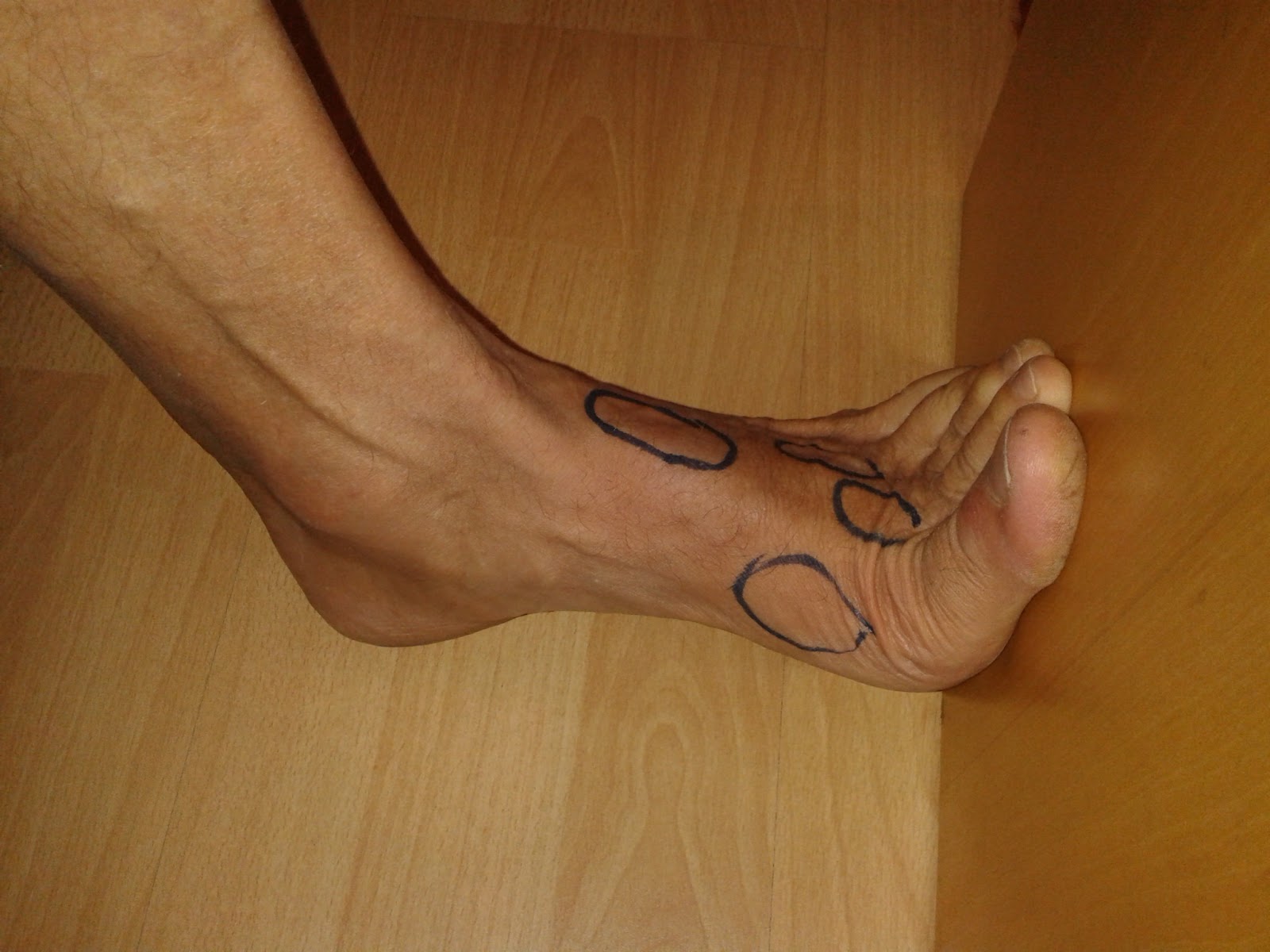
As predicted, after a few days my pain started to become localised. But it did so in strange places as marked below:


This was confusing! There were tender spots all over my foot and these were not indicative of a stress fracture - what was the culprit - I wondered morbidly if I had two or more stress fractures! Certainly the prospect of a 1st met stress fracture was very unusual as was a fracture of the navicular or cuneiform bones in the ankle. I was dismayed. I really couldn't work out what the issue was. I also had pain around the outer/lateral ankle bone (malleolus) at the point where a few tendons wrap around it (tibialis). I was stumped in more ways than one.

After a week of no running I started extending my walks and at this point I convinced myself that if I was suffering from a stress fracture it should prove itself and turn into a proper fracture. I'd get an-x-ray and would know the prognosis. And if it was not then I'd simply carry on with impunity. I constructed my own convoluted "win win" scenario ... or so I thought.

Simultaneously I started massaging my foot with anti inflammatories and I used my thumbs fairly aggressively to pummel the hot spots, leaving me purple and bruised. During this period of self abuse it suddenly occurred to me that many foot problems emanate from the calf muscles (too tight) especially the deeper calf muscle known as the soleus. And so I worked my thumbs into my lower leg until I found the KNOT!


At the same time I started doing some stretching of both the calf and the plantar. These were very tight and I knew I had to do some deeply invasive stretching. Simply place the foot against an upright surface, with toes extended upwards and manoeuvre the knee forwards, thus stretching everything from the calf to the toes (perhaps even the glutes).


Importantly this started to yield results and after 8 or nine days since the injury occurred I ventured forth on a gentle 3km run,  then two days later on a 5 km, and then more. Now two weeks later to the day and hour, I feel back to normal and am not suffering the indignation of another obsessive "too soon too much" outburst. It was simply a little soft tissue damage. Sorted!

Feet happy again in the old Pocket Rockets. But it does confirm that a little problem can refer to a far wider area and cause a disproportionate amount of distress.


Sunday, 5 October 2014

The Non-Definitive Guide to Running a Barefoot Marathon (Hint: Plan not to do this)

OK so you want to run a barefoot 42? Well, that's the first mistake. You must definitely not have this as a goal. Do not put it on the radar screen. If you profess to want to run a barefoot marathon you will start to obsess about your feet, you will fear the possible damage, and the insults, and generally your mental condition will deteriorate to the point that you will not succeed. So the first point is this. Tell yourself,  "I do not want to run a barefoot marathon", then go and run a few barefoot miles. That's the start.

I am not an expert. I have run only one barefoot marathon. That is unimportant. If you ask someone that has run 100 barefoot marathons they will give you all sorts of misleading advice. They will say it's easy, you wont take any strain, and so on. They will say these things because they have forgotten what it was like to run their first. So I am writing this before I too am sucked into the vortex of memory loss and delusion.

The first part of the plan is clear. You DON'T want to run a barefoot marathon and you must believe this implicitly. The next part is to make sure that your conviction holds true for at least 3 years or more. This can be achieved in a number of ways. Upon waking every morning you can repeat to yourself  "I do not want to run a barefoot marathon". Alternatively you can adopt a more aggressive mantra along these lines, "People that run barefoot are mentally deficient delinquents with no sense of style or occasion" (you may choose your own expletives if you please).

By now the plan should be taking shape. You have given yourself at least 3 years grace. During this time progress as quickly as possible to the thinnest most unprotective footwear you can find. And if you can't find anything in your local Nike shop then go home and fashion something out of old carpets or car mats. Do not worry about what any of the experts tell you. If you get a sore foot keep running. This may exacerbate your stress fracture turning it into a full-blown displaced fracture but this is a small and insignificant inconvenience. Remember that when the fracture heals it creates a stronger portion of the metatarsal. This is "strength" building of the highest order.

After 2 or 3 years you should be comfortably running in your minimal footwear and perhaps even doing a few barefoot miles here and there. But the bottom line remains - you do not want to run a barefoot marathon. By this stage you will know that you do not want to run a barefoot marathon because your irregular barefoot runs will be fraught with drama. You will find glass embedded in your feet, toxic thorns  (we have these around here) will sink into the soft flesh at the base of your toes and cause painful swelling. Your feet will ache at times and you will doubt your chances of full recovery. Indeed there will be moments of  such intense pain  -- when you land, full stride on unseen prism shaped stones -- that you'll be reduced to infantile tears.

But this is nothing because you know you do not want to run a barefoot marathon. However your 3 years, your holiday, your sabbatical are now coming to an end. This is the time for some stealth planning. By this I mean you need to make plans in such a way that you yourself do not fully realise the implication thereof.  Make plans that even you cannot unravel, Stealth Plans. Oblique strategy!

Firstly find an accomplice, or in my case two. Find someone to do a few longer barefoot runs with. Preferably choose someone that will ridicule your motivations because in a contrary manner this will only strengthen your resolve at a deeply subconscious level. Your brain knows you are not a barefoot runner and you secretly despise those that are, but you need to sow the seeds of a different theme in your subconscious. And the mocking from your accomplice will help. In my case I solicited a second accomplice to actually run with me on my marathon attempt. The main purpose, as I saw it, was to deflect any insults and derisive outbursts from the bling-shoe parade.

Trevor, my accomplice registering for the Cape Town Marathon

At this time you should be comfortably battling through a few barefoot runs each week. It is better to take these longer runs on the worst road surface you can locate. This will prepare you in a rather perverse manner. Do not try and run barefoot everyday. Rather run far and then switch to minimal shoes for a day or two before going barefoot again. This allows the feet to get tougher.

The next part of the Stealth Plan (remember, you are an unsuspecting participant), is to locate the marathon you don't think you should run, certainly not barefoot. The most important thing is surface condition so do not choose an event in a derelict, decaying and generally decrepit town. Another important variable is weather. Make sure the experts are not expecting a blizzard and that the early morning temperatures for the race will not cause frostbite in your lower extremities. Then do not enter it. Not until the very last moment. In my case, at the last minute, the entry cut-off was extended by a week. This was a windfall. I had a whole new week to not enter. You do not want to enter until the last moment because as soon as you pay your fee, the Stealth game is up. Whoops? Am I going to run this barefoot? Yes dude, you are! You are now trapped in your own web of deceit.


After 3-4 years of not wanting to run a barefoot marathon you will now have a week or two to evaluate your sudden change of stance. A pitiful evaluation nonetheless. These will be taper days and you will be unable to squeeze in any last minute furtive sprints around the block. But importantly that morbid dread will only corrode your stomach for the short time remaining until the race start and not a full 3 years.


Race registration

And so to the race, or rather the day before. You should be barefoot all the time, not to run, but to walk and play. Do not lie in bed and do not lie in a bath. In fact do not shower or bath before your run. Keep your feet hard. Your plans for the race should also include all sorts of escape tricks. Carry some phone numbers, some spare cash and if you can, carry some back-up footwear or have it stationed at places on the run. Running barefoot puts different stresses on your lower legs and abdomen so take some electrolytes to prevent the chance of cramping in strange places.

Now the race itself. The first thing that will strike you is that you cannot easily run amongst a big start crowd. Barefoot runners need at least 3 or 4 meters of clear road ahead so that you can see, anticipated and avoid small yet dangerous items. Move to the side of the group if you can. Besides some clear road ahead,  you will also need some leeway to the left and the right. Yes, your lurching to avoid those dangerous items means you need space. Alternatively find some people that wont mind you crashing into them as you weave erratically from time to time.

Messing around before the start

Another big difficulty is predicting your time. This is your first barefoot marathon and as such it is littered with unknowns. How fast, how far, how tired, how sore ... you don't even know if you'll finish. My suggestion is to not take a watch. It will be of little use. Your running will be mindful, as you focus intensely on each stride and foot placement. You will determine your pace through a complex algorithm incorporating feel, expected feel, surface, expected surface, heat, need for reserves, possible issues, and more. Your brain will do this for you. Not your watch.

Runners spread over a wide area. Not sure where the start is!

And on the day, if you're lucky enough, you will feel light and strong. The regular outbursts from the spectators will motivate you. "Look a barefoot runner, that's amazing!"  Your feet will connect truthfully to the ground and the contact will inspire you, each positive step followed by another. The tactile joy of sensory messages filling your brain. And your eyes will fixate on the road ahead and slowly you will escape to a separate reality of primal motion. If you're lucky enough you will lose a sense of time as you fixate on cadence, stride length and foot placement. The distance markers will pass but you will not see them as the self absorption becomes complete. Passing the halfway mark you might be lucky enough to notice that you're OK, and if nothing has gone wrong you may still have a very good run. And your focus will return to the road, that 3 meter horizon and the breathing .... always breathing.


And if you're lucky enough you may get some long hills that allow you to work a little harder, measured effort. And still more spectators, and other runners calling out "well done!" This will inspire you to move more deliberately. You will know that the long time spent conditioning both your legs and your core, your feet and the toughening of the soles, will be worthwhile. You will feel compelled to run cleverly, efficiently and as you pass those that are slowing into the final 10km you will start to move with a little more resolve and a little more passion.


And if you're really lucky you will finish with a big glow of satisfaction and exuberance. You will feel invincible and know that the skeptics are wrong. The pure delight of unhindered running will resonate in your mind as you relive the full distance.  You will probably think a little more deeply and reflect on the fact that you have now run a barefoot marathon. And once noticing that it is done you may very well decide that planning not to do this was better than no plan at all.

Trevor and I drank beer afterwards. Quite a lot.

Reluctant to move on!


Sunday, 24 August 2014

T Rocket Hominid Sandal Review in Barefoot Running Magazine

Find the latest issue of Barefoot Running Magazine here:
http://issuu.com/davidrobinson0/docs/barefoot_running_magazine_issue_12_

A full independent review of T Rocket Hominid sandals on page 146.